Biographer's Preface
Opening to The New House 2: The Chapel of Humiliation

(This marks a brief detour from Spine & Arp)
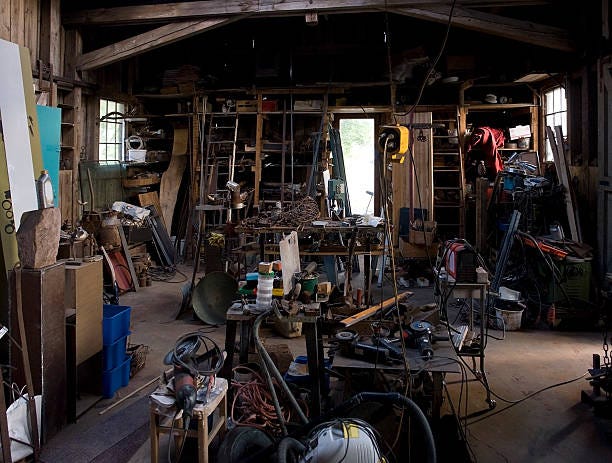
I am writing this in the garage, hoping that one day, when I’m finished, or at least not too long after that, I will be let in to the house, across the driveway and up the back stairs and into what will then, by dint of my hard work, at last have become my home, the one place where I may finally rest. I don’t know why I think this—I am, even now, sane enough to acknowledge that no one promised me any such thing—but, even so, it is all that keeps me going.
The Night Crusher lumbers along the path between the garage and the house, patrolling the no-man’s land that I long ago gave up any fantasy of trying to force my way across before my work was done, much as that notion still appeals to me. If the Night Crusher came into the garage today or tonight, I would try only to convey that I am no threat, that the lack of courage I displayed at Yale, all those years ago, at the beginning of my relevant life, so to speak, is still coursing through my system, and thus that he needs only to leave me here a while longer, with the door open even, after which time I will emerge meekly with my pages in hand, blinking in the sunlight and begging for water. The will to, on the one hand, shirk my duty to Jakob’s life so as to live my own, and, on the other, to usurp Jakob’s role in his own life so as to come into my own from inside of him, like an infant from its mother, has long since ebbed out of me, leaving nothing but a calm and humble witness to long-past events.
***
Yale. I think back on it now, all those years ago, the “early 80s” according to the calendars in the boxes beneath the rolls of asbestos in the unfinished loft overhead, when Jakob, already world-famous (arguably more famous then than he is now) dragged his chain of heads up onto the burnished auditorium stage to deliver that year’s Eliot Lectures, a watershed moment in the history of art in this country, if I am to be believed—and if I am not, then who am I talking to?
The thought of ending up alone with this story, beneath that creaking loft, discomfits me now in much the same way that Jakob himself did when I first met him at Yale. I was working then as a teaching assistant for an undergraduate studio art course, which Jakob—at the request of Professor Dalton, my nominal employer—deigned to visit on an off-day between his lectures. I came to class early to turn on the lights and set out the paper and drawing materials for the students, who would surely, despite the immense gift they were being given, turn up late, if at all. When I arrived, with my coffee from the student snack bar in one hand and a greasy scone in a paper bag in the other, I assumed I would be alone, as I would have been on any other morning, in the clean, cool studio space before the day truly began. But even before I turned on the lights, I knew this morning would not be like all the others. Despite all I’m prepared to divulge in the pages to come, I’m still at a loss to convey what it was like to perceive Jakob sitting there silently in the dark, behind a locked door that (if he weren’t what I’ve come to believe he is) he couldn’t possibly have opened on his own.
When I saw him sitting on a stool in that studio, leaning against the common worktable like a common student, though far more elegantly dressed, I froze beneath the light switches, wishing I could turn them off again and take my coffee and scone into Supply Closet B and spend the rest of the day in there, because I knew, more clearly than I’d ever known anything up to that point, that if I approached him in good faith at that moment—if I left the lights on and strode to where he sat and introduced myself while taking a seat beside him—that he would become my whole future. He would bless me in the same way that some transcendental force had clearly blessed him, and then I would either join or become him, and my life would be made.
***
Had any of that happened, the years and years of bitter struggle, of living as a nobody in one New England town after another only to end up here, devoting what may be my final days to a mere biography of the Great Man, trapped in a garage by a Night Crusher who has no incentive to let me out, would never have come to pass. If only I’d summoned the courage to approach Jakob when he presented himself, or when fate presented him to me, in that studio classroom at Yale… if only… if only.
But, needless to say, I did not. I didn’t come anywhere close to such a feat. I stood beneath the light switches and stared at him while he stared straight ahead, at nothing or at what only he could see, calmly indifferent to my quavering presence. I stood there and waited for Professor Dalton to arrive, along with those few students who grasped the magnitude of the opportunity he’d arranged for them. Then I merged into the background, becoming little more than a piece of equipment, doling out drawing materials and focusing the overhead projector and bringing Jakob a glass of water when he requested one, partway through his lesson, from which I absorbed nothing at all. After class we repaired to the Faculty Club for lunch, where I likewise failed to engage Jakob in any way whatsoever, save perhaps for a few remarks so cursory and commonplace that I would’ve been ashamed to commit them to memory. Whatever my notion of myself may have been at the time, it became clear that I was capable of nothing more.
***
All of which goes to illustrate how I threw the better part of my life away that morning at Yale, shrinking when I should’ve done all I could to grow. I fell or was easily pushed from there into a desert of years on whose far side (or, for all I know, in whose middle) stands this garage, where I work day after day on the story of Jakob’s life as best I understand it, having convinced myself that if I tell it correctly, setting down for posterity the testament that Jakob himself has always been too immersed in his work to step back and consider, he will then materialize to deliver me—he, a man who, after that aborted morning, I often fear I never once saw again and thus, to be perfectly frank for the first and likely the last time, I never knew at all.
But then again, there are times, after I’ve worked myself past the point of lucidity, or else into a lucidity I otherwise never approach, when I think the exact opposite may be true: times when I think I know Jakob in a way that no one else ever has or ever will. There are even times, and I’m beginning to suspect that now is one of them, when I come to see that there never was any Jakob except the one I’ve conjured here in this garage, and thus there is no one at all in the house on the far side of the Night Crusher’s patrol, no one waiting to let me in when my work here is done. At these times, I am at last able to accept that I am the only Jakob, and that it is thus wholly within my power to doom that boy who was too afraid to approach me at Yale and take some of my burden onto himself, to an eternity of imprisonment, far from home, wandering back and forth and back and forth again across what I have here, in this garage—this garage that is the only place I’ve ever belonged or ever wanted to belong, where all my great work has taken shape, the work that earned me that stage at Yale in the first place—decided to call the Chapel of Humiliation, a room of infinite scope in which that boy, who once believed he wanted to become Jakob, will now spend eternity, because I’ve decided that he should and because decisions like this fall to me and to no one else in the universe.