Arp in Sicily
A run-in with a nun

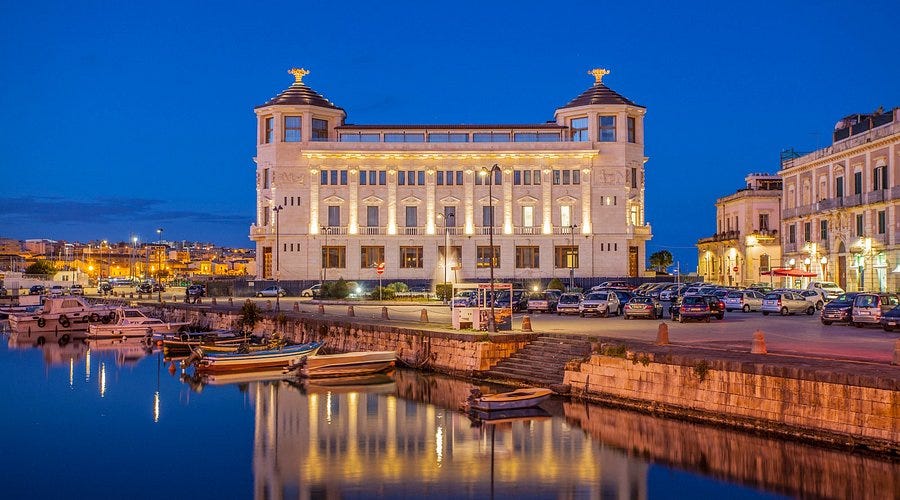
Sitting at the table in that rundown kitchen with the sun setting outside the windows, Arp sips his coffee, munches an Oreo, and wonders what, indeed, he came here to talk to Spine about. Yalta, the railway carriage, the worked-over treaty: he glances at a bookcase lined with Naguib Mahfouz volumes and decides to believe that the record of the decisive conversation he would’ve had with Spine is contained on a comparable shelf in another room.
Here, in this room, both he and Spine are covered in scrapes and bruises, the result of a scuffle or attack that neither quite remembers—or, if either does, that neither is ready to mention. Thinking of Mahfouz’s Cairo, Arp thinks then of Durrell’s Alexandria, whose sparkling harbor and chaotic market squares lead him partway across the Mediterranean to the city of Siracusa, in southeastern Sicily, and into a lavish hotel room where he finds himself masturbating beneath a painting of a nun in an austere basilica.
“But it was really,” he begins, all at once aware that this is what he came here to tell Spine about, “because of something I’d seen at the beach earlier that day. There was a young woman whose bathing suit had slipped ever so slightly to the side as she climbed a set of stairs off the strand in front of me, and, well, being fifteen myself at the time, having never before seen what I saw then, there was simply no way to hold in what had only a few years earlier begun to demand its way out of me.”
If Spine blushes in the fading light, he does so invisibly.
“So I ran back to the hotel room I was staying in with the elders who must’ve brought me there, went into the bathroom, filled my hand with the lemon-verbena lotion that was on offer, as if precisely for this purpose, and did what I had only recently learned to do. As ever, I felt so much better afterward. Well enough, in fact, to lie down by the open window and breathe the sea air and drift into a mild afternoon doze. For a moment, anyway. But before my eyes fell all the way shut, they alighted on the stern, cragged face of another nun clutching a rough-hewn wooden cross on the wall above the bed. I could swear her eyes turned down to reproach me where I lay.
“I knew that, as long as her gaze remained fixed upon me, I would be frozen right there, locked within what I could only imagine was her damning appraisal of what nature had forced me to do. Her reproach was so powerful, so certain, that I began to quake. She pulled me in far more powerfully than that girl from the beach ever could have, despite how feverish my imagination, when it came to bikinis, in those early years surely was. That nun sucked me through the wall and into her nunnery, where, all of a sudden, I was seated at an immense mahogany table in a white raiment while a tribunal of Mothers Superior sat in judgment around me, the younger nuns seated silently on pews behind them.”
Spine seems shakier than he’d seemed when he sat down, as if hearing this story has weakened him, or even caused him to become slightly less real, though perhaps, Arp allows, it’s only the Maxwell House coffee he’s gone on drinking and drinking. (As if offended by his own over-consumption, Spine wobbles over to the counter, puts the coffeepot back on the burner, takes an open bottle of white wine from the fridge and puts it on the table along with two juice glasses, which Arp understands he’s meant to fill before continuing his story.)
When they’ve each taken a few sips, Arp says, “And so there I was in that nunnery, fighting for my life. The charge, I came to understand, was that of impregnating every single nun in there. Every last one, siring a race of degenerates whose provenance would normally be attributed to the Devil.”
He shudders to hear himself say this, an admission he’s made to no one else. He drains his juice glass, refills it, and drains it again. Then he continues, “The punishment they were loudly considering, for the crime I stood accused of—and the faces of those nuns, inside their wimples, did indeed, to varying degrees, resemble that of the girl I’d fixated on at the beach—was burning at the stake. The classic move, and one that, within the paradigm I’d been pulled into by that nun on the wall, I could hardly claim not to deserve. But it was precisely then, as so often occurs when one is faced with the absolute, that the idea which has defined my entire subsequent life occurred to me. ‘What if,’ I interjected, forcing the Mothers Superior to look my way, ‘I instead took responsibility for all those degenerates who have already been or will soon be born from the blameless novices arrayed here behind you, whose virtue I have so unjustifiably assailed?’
“The Mothers Superior eyed me slowly and carefully, as if to gauge whether I quite understood what I seemed to be saying. ‘You mean,’ one of them finally asked, ‘that you will be the God of a new world? An entire world populated entirely by your offspring, for whom you alone will be responsible for all time?’ Unsure quite what I was getting myself into, nor how much I would come to regret it if my request were honored, I nodded. ‘Yes, Mother. That is it precisely. Allow them to be born and leave them to me. I will align my eternity with theirs, so to speak—in whatever world you see fit to release them into, I will shepherd them from one side of it to the other.’”
“So that’s how you became God?” Spine asks, with a look on his face that oscillates between sarcasm and its opposite.
“In so many words,” Arp replies, awed at the magnitude of what he’s just admitted. “In that sense, I am your father and we are still in Sicily.”
The kitchen, filled with the darkness that has descended over the lawn outside, comes to rest as a lonely ruin in a rocky Sicilian valley, abandoned by Greece, Egypt, Rome, and even present-day Italy. Claimed by no one except Spine & Arp.
“The Treaty we signed in Yalta,” Spine adds, when he’s absorbed the possibility that this situation pertains equally to him, “was it merely your formal admission of what you’ve just told me?”
Arp looks at him incredulously. “There’s no Yalta, Spine,” he says. “There’s not even a Russia or a Germany. No China, no Japan, no nothing. There’s only this house, with you and me in it, and the nuns in their convent up the hill, brooding over our circumstance in ways we are not permitted to overhear. My original terror of being expelled from the hotel in Siracusa where I did what I did? It both has and hasn’t come true. In a sense that is only now dawning on me, the judgment that I used to believe was rendered unto me at the outset of this universe has actually not been rendered yet.”
He looks around the kitchen to force a pause. “I don’t know what more to say. I was told that a vast degenerate race would be born from my transgression, but you’re all that came out.”
Both of their noses begin to bleed, dripping past their chins and into their collars. They sit there in the dark while it pools on their chests and the darkness out the window deepens. Then the lights come on in the convent, on a rocky crag above the valley they’re nestled in, and they know that whatever’s about to happen—if anything is—will happen only after the Tribunal that has been convened up there reaches its final decision.
As if to encourage them in this line of reasoning, priests and sorcerers march up the hill holding torches that illuminate their triangular hats, thickening in the yard just outside the kitchen while Spine & Arp watch with the last of their wine.